

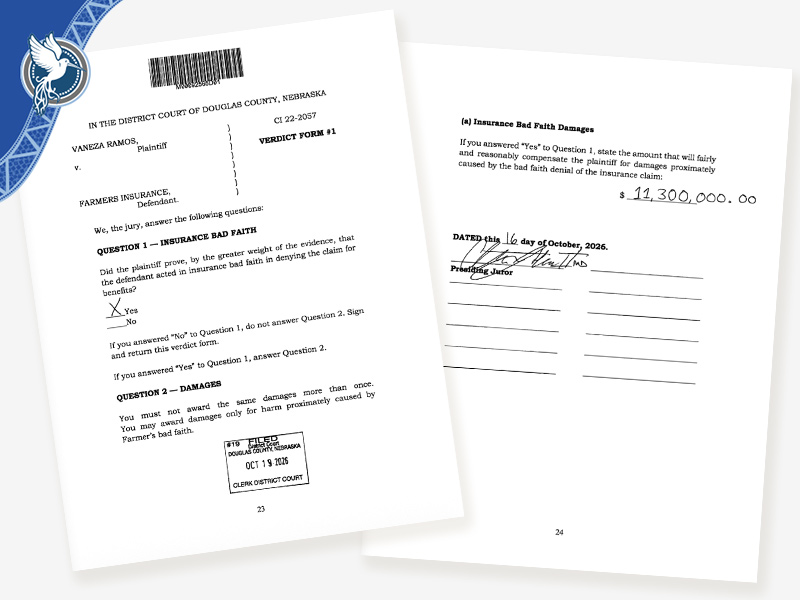
Pesek Law attorneys Ross Pesek and Alejandra Ayotitla represented an Omaha mother of 10 in a life insurance bad faith case against Farmers Insurance. On Oct. 16, 2026, a Douglas County jury awarded $11.3 million in damages.
“A Promise to Protect Should Not Be Broken”: Pesek Law Secures $11.3 Million Verdict in Insurance Bad Faith Case
On October 16, 2026, a Douglas County jury awarded $11.3 million to an Omaha mother of ten in an insurance bad faith case arising from the denial of her late husband’s life insurance claim. Pesek Law attorneys Ross Pesek and Alejandra Ayotitla represented her at trial.
The verdict followed years of litigation and two jury trials. Behind that legal process was a family trying to move forward after losing a husband and father during the COVID-19 pandemic.
At the beginning of the trial, Ross Pesek reminded jurors of a fundamental principle:
“A promise to protect should not be broken.”.
hat promise, and the consequences of breaking it, were at the heart of the case.
The Protection a Family Counted On
The client and her husband raised a blended family of ten children and operated a family owned business in Omaha.
Her husband already had life insurance when a Farmers agent approached him about moving his insurance business. In 2018, he replaced his existing coverage with a $350,000 life insurance policy from Farmers. The new policy was intended to replace his income if he died. Premiums were approximately $800 per month.
In May 2020, the client gave birth to their youngest child. Later that month, her husband was hospitalized with COVID-19. He died on May 31.
While grieving and caring for a newborn, she sought the life insurance benefits her husband had purchased to help protect their family.
A Denial and a Dispute Over What the Insurer Knew
Farmers denied the claim in September 2020, citing answers about her husband’s medical history on the insurance application. The company offered to return approximately $17,000 in premiums rather than pay the $350,000 benefit.
The client refused to accept that as the resolution.
At trial, Pesek Law challenged the insurer’s position by focusing on information available before the policy was issued. That included text messages notifying the agent of a hospitalization and confirming that it involved her husband’s heart, along with disclosures in a later medical questionnaire.
The trial team argued that the agent had entered incorrect answers on the application and that Farmers disregarded information that should have prompted further investigation before approving coverage and collecting premiums.
Farmers maintained that its investigation supported a reasonable basis for denying the claim. The significance of those disclosures, the agent’s knowledge, and the company’s handling of the application were central disputes presented to the jury.
Two Trials, Two Distinct Questions
In March 2026, a Douglas County jury found that Farmers breached the insurance contract, rejected its fraudulent misrepresentation defense, and awarded the $350,000 policy benefit.
The October trial addressed a separate question: whether Farmers acted in bad faith and what harm its conduct caused the client.
The second jury was not being asked to award the policy benefits again. It was being asked to evaluate the consequences of the insurer’s conduct beyond the unpaid contract.
The Human Cost of the Denial
The trial examined the client’s efforts to sustain the family business and care for her children without the insurance funds she had expected.
The evidence presented on her behalf described financial pressure, borrowing from family, business obligations, and the repossession of her husband’s truck.
Her mother moved into the household to help care for the children. Her son, who had recently graduated from high school, set aside his plans to take on substantial responsibilities in the family business.
The insurer disputed the extent and cause of the claimed damages. The Pesek Law trial team asked jurors to consider how the denial compounded an already difficult situation and to assess the resulting harm.
As Ross explained in his closing argument:
“It’s not based on the contract. It’s based on the harm.”
The jury returned an $11.3 million verdict.
David, Goliath, and the Power of a Jury
Throughout his closing argument, Ross drew on the story of David and Goliath to explain the imbalance of power between an individual and a large corporation.
He reminded jurors that treating both sides fairly did not mean ignoring the differences in their resources or ability to withstand a prolonged legal battle.
Ross told the jury:
“There is one moment that even Goliath fears. It’s this moment. It’s accountability because of a jury.”
For years, the client faced an insurance company with substantial resources to investigate, defend, and litigate its position. She had to find the determination and support to continue pursuing her case.
A jury trial gave her the opportunity to present that case to members of her own community and ask them to decide whether the insurer should be held accountable.
That is one of the most important functions of the civil justice system. No matter how powerful an institution may be, its conduct can be examined and judged by ordinary citizens.

Preparation, Persistence, and Faith in the Jury System
This case required years of work, close examination of insurance records, and preparation to present two distinct claims through two jury trials.
But preparation alone was not enough. The client also needed the determination to continue through years of litigation while raising her family and running her business.
Near the end of his closing argument, Ross spoke directly to the jurors about that persistence:
“Takes faith. Takes faith for Miss Ramos to think that maybe someday there’ll be justice in our community and our world. That if she just holds the line, maybe someday the table will turn. It’ll be up to you to decide if that day is today.”
On October 16, 2026, the jury delivered its answer.
The case reflects Pesek Law’s commitment to understanding the human story behind every case, preparing thoroughly, and pursuing accountability through trial when necessary.
It also reflects the determination of a woman who continued pursuing her case for years and the important role of jurors who gave their time and attention to the evidence.
Their service made it possible for this case to be heard and decided by members of the community.
Together Toward Justice.

 ESPAÑOL